
In defense of Bierberchella
Over the weekend, Justin Bieber delivered one of the most divisive, yet undeniably headline-grabbing , festival sets in recent memory. Reportedly commanding a US$10 million fee, his performance blended his new Swag era with deeply nostalgic callbacks, drawing massive crowds while leaving critics split.
As a first-time headliner, Bieber didn’t lean into spectacle. Instead, he stripped it all back.
The performance
Bieber walked onto a bare stage in a red hoodie and shorts. There was no elaborate set, no dramatic opening. Then came the twist: a laptop.
Bieber began searching for his old videos and memes on YouTube, turning the performance into something closer to a live archive than a traditional concert. He sang alongside clips of his younger self, revisiting Baby, Beauty and a Beat and Favorite Girl.
At one point, he performed With You — the very video that helped propel him to fame — effectively duetting with the moment that started it all.
It was chaotic. It was unconventional. And for many, it was confusing.
The problem
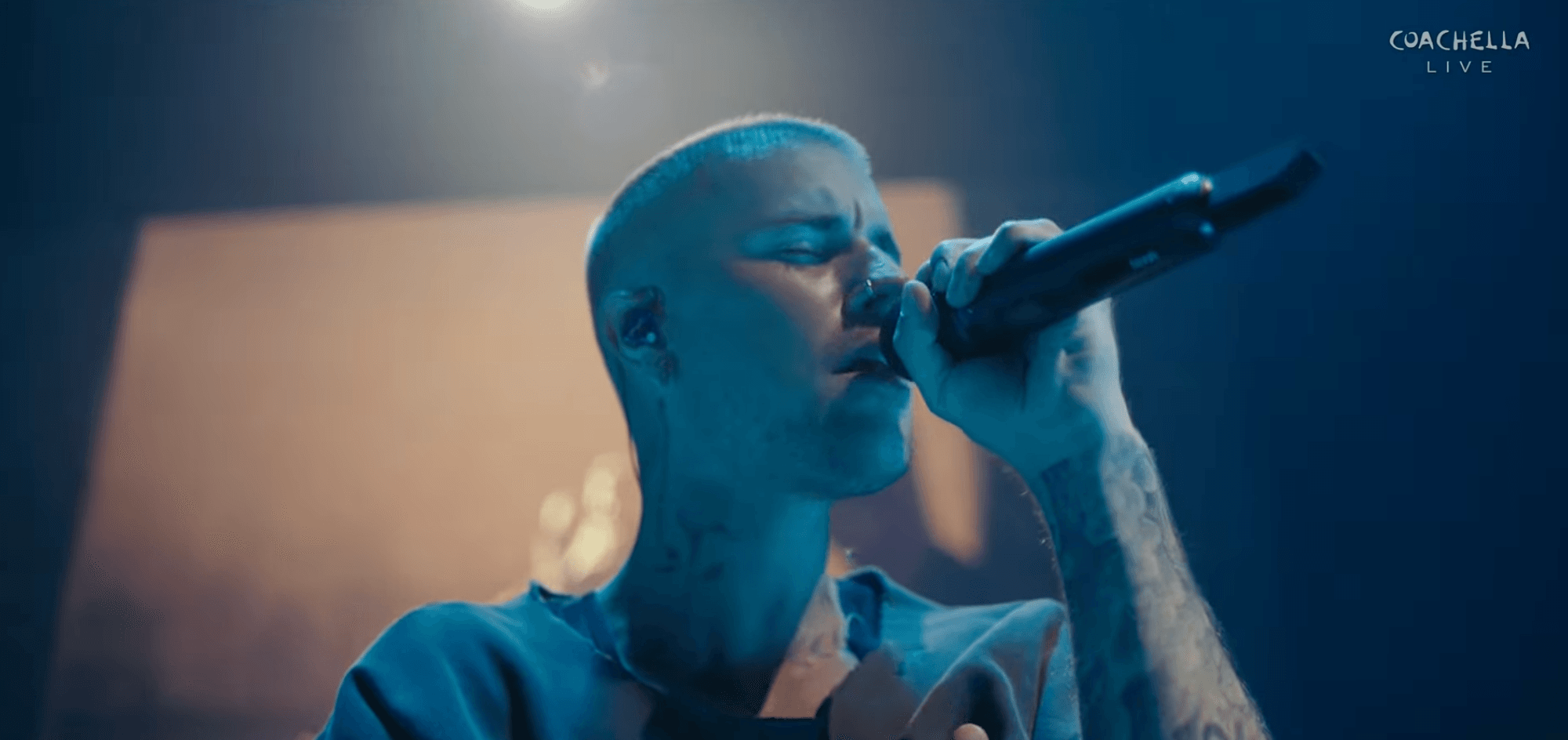
Critics were quick to land on a single word: lazy.
For a US$10 million paycheck, there were no dancers, no costume changes, no major lighting effects, no grand production to speak of. In an era where pop performances are expected to be maximalist, Bieber’s minimalism felt almost like a refusal.
Placed next to artists like Sabrina Carpenter, whose shows are tightly choreographed, visually rich, and relentlessly polished, the contrast becomes even harder to ignore.
It also raises a broader question: if female artists are expected to be bedazzled, choreographed, and larger-than-life at all times, why are male artists more readily excused for doing the bare minimum?
It’s a criticism that doesn’t just apply to Bieber, but his set put it front and centre.
The defense
This isn’t to argue that the performance was flawless or even that it justified its price tag.
But what many seem to miss is this: the performance was Justin Bieber.
At a time when artists and brands alike are leaning heavily into nostalgia, Bieber is uniquely positioned to weaponise it. Few artists have grown up as publicly, or as recognisably, as he has. And he knows it.
By revisiting his old catalogue in such a literal, almost unpolished way, he turns time into part of the show. Fans aren’t just hearing the songs. They’re watching the distance between who he was and who he is now.
That emotional arc hits differently when you factor in his very public journey of early discovery, global superstardom, burnout, cancellations, and a gradual shift into a quieter, more low-key version of himself.
Even the use of YouTube wasn’t accidental. Bieber was discovered on the platform, and by searching up old clips and memes onstage, he collapses the gap between global pop star and internet kid. The massive festival stage suddenly feels smaller, more intimate, more human.
Spectacle vs. access
To put on a show with massive effects, costume changes, and a cavalry of dancers is to give audiences exactly what they paid for — a polished, high-production performance that justifies the price tag.
To step on stage in a hoodie, fiddle with a laptop, and sing along to old clips is to offer something else entirely.
It’s not bigger. It’s not grander. And it’s definitely not more impressive on paper.
But it is personal.
Because that kind of access — unfiltered, a little chaotic, almost careless — isn’t something you can replicate with budgets or stage design. It only works because it’s him. Because the history is real, the footage is real, and the audience has lived through it with him.
You can buy spectacle.
You can’t manufacture that level of familiarity (unless your name is Hailey or Jack Bieber.)
So, was it enough?
Whether the set reads as disrespectfully minimal or emotionally resonant depends on what you value in a performance.
But one thing is certain: this wasn’t accidental.
This is Bieber’s new era — quieter, more self-aware, and rooted in reflection rather than spectacle. You better believe it.